
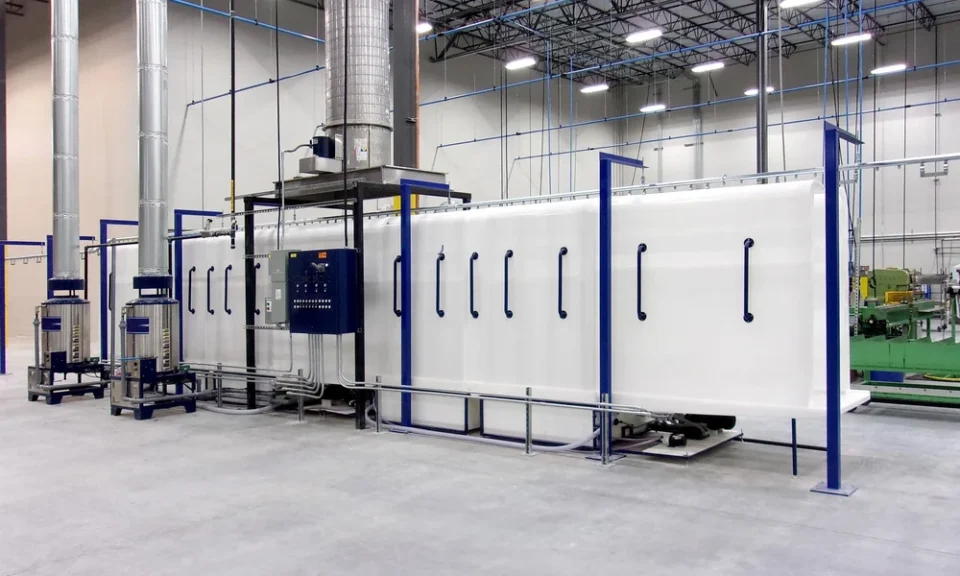
A well-planned powder coating line supports far more than the moment powder reaches metal. Preparation, application, curing, handling, inspection, and production timing all depend on equipment that works as one connected process. Manufacturers that understand how each stage fits together can build a finishing operation that handles everyday work efficiently while leaving room for changing part sizes and higher output.
Surface Preparation Gives the Coating a Better Starting Point
Clean metal provides the foundation for reliable powder adhesion because oil, rust, scale, and fabrication residue can interfere with the finish. Depending on the product, preparation may involve washing, blasting, degreasing, rinsing, or chemical pretreatment before components ever reach the application area.
Proper coordination between preparation and Reliant powder coating equipment keeps cleaned parts moving forward without long delays that could allow contamination to return. Businesses benefit from treating pretreatment capacity as part of the overall finishing line rather than increasing spray speed while leaving an undersized cleaning stage behind.
How Does Controlled Powder Application Improve Daily Output?
Electrostatic application helps charged powder particles move toward grounded metal, allowing operators to build a controlled film across flats, corners, and complex shapes. Gun settings, grounding, powder flow, nozzle selection, and airflow all influence how consistently that coating reaches the intended surface.
Reliable application becomes easier to repeat when a Reliant powder coating equipment package is selected around common part dimensions and production volume. Shops comparing Reliant powder coating equipment for sale can use those factors to choose capacity that supports steady throughput instead of forcing crews to compensate for equipment that is too small or unnecessarily large.
Color Changes Depend on Cleaning and Powder-Handling Discipline
Frequent color changes can consume valuable production time if powder remains inside hoses, guns, booth surfaces, or delivery components. Organized cleaning procedures reduce cross-contamination and help operators switch from one finish to another without producing several rejected parts before the new color runs clean.
Dedicated powder components may also make sense for colors used repeatedly during the week. Flexible Reliant powder coating systems can support businesses handling varied customer work by giving crews a structured application process while still allowing batch schedules to change as orders, colors, and quantities shift.
Curing Turns Applied Powder Into a Finished Coating
Heat transforms loose powder into a continuous film and allows the coating chemistry to complete its cure. Powder coating ovens must bring the metal itself to the temperature specified for the coating, which makes part thickness, rack weight, and load density important parts of cycle planning.
Consistent Reliant powder coating ovens help businesses schedule that stage around real thermal demand instead of simply timing how long parts remain inside a hot chamber. Accurate curing can reduce rework, protect coating durability, and keep downstream assembly from waiting on parts that need a second heating cycle.
Why Material Handling Matters Between Spraying and Curing
Freshly applied powder remains vulnerable until the part reaches the oven, so unnecessary contact can leave marks that become permanent after cure. Racks, carts, hooks, floor tracks, and overhead handling arrangements help components move from coating to heating with less touching, turning, or manual repositioning.
Straightforward movement also improves labor efficiency because employees spend less time maneuvering awkward loads through crowded aisles. Manufacturers processing heavy or oversized products may pair appropriate handling equipment with a Reliant industrial powder coating oven so large assemblies can travel through the finishing process without becoming difficult to load safely and consistently.
Temperature Verification Makes Cure Times More Reliable
Controller readings only show oven-air temperature, while thick steel may still be absorbing heat well after the chamber reaches its setpoint. Temperature profiling, contact probes, and documented cure schedules help operators determine when the actual metal enters the coating manufacturer’s required cure window.
Recorded data gives supervisors a useful reference for recurring products and makes changes in oven performance easier to notice. Buyers reviewing a Reliant powder coating oven for sale can therefore consider airflow, recovery, heating capacity, and monitoring needs alongside chamber dimensions, helping the business choose an oven around process control rather than physical fit alone.
Inspection and Production Records Turn Finishing Into a Repeatable Process
Finished parts should be checked for appearance, film thickness, coverage, cure quality, and other requirements that matter to the product. Inspection records can reveal patterns tied to a certain rack arrangement, powder setting, oven load, or operator practice, allowing teams to correct the process instead of repeatedly repairing finished parts.
Useful documentation also connects production planning with maintenance because slower heat-up, changing airflow, or repeated coating defects may point to equipment needing attention. Reliant powder curing ovens become more valuable to a business when cure profiles and maintenance history show exactly how the heating stage performs over time.
A Complete Finishing Process Works Best When Curing Capacity Sets the Right Pace
Balanced production requires each step to feed the next without creating long queues between preparation, spraying, and cure. Faster application does little for daily output if coated racks regularly wait for oven space, so manufacturers should consider thermal load and recovery time as seriously as booth speed.
For manufacturers building a more connected finishing process, Reliant Finishing Systems offers powder coating ovens and equipment packages that bring application, curing, and material flow into the same production plan. The company’s oven options can be configured around part weight, cure temperature, batch size, and loading method, while complete packages give shops a practical way to coordinate the equipment surrounding the cure stage instead of piecing the line together one component at a time.
